1. Metabolic Adaptation
As body weight decreases, the body requires fewer calories to function. At the same time, metabolic efficiency often improves, meaning fewer calories are burned during daily activities.
SelfCareSupport
Many people experience the same frustrating moment during a weight loss journey: after weeks or even months of progress, results suddenly slow down or stop completely. This phase is commonly known as a weight loss plateau.
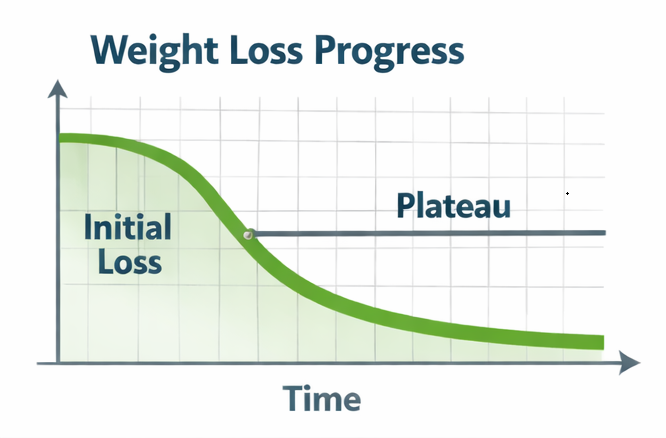
Despite popular belief, a plateau is not a sign of failure or lack of effort. In most cases, it is a predictable biological response driven by how the human body adapts to change.
Understanding the science behind weight loss plateaus can help explain why they happen — and why pushing harder is not always the most effective solution.
A weight loss plateau occurs when the body stops losing fat despite continued dieting or exercise. Calorie intake and activity levels may remain unchanged, yet progress on the scale stalls.
Research in metabolic physiology shows that the body constantly works to maintain balance, a process known as homeostasis. When weight loss continues for a prolonged period, the body adapts in ways that conserve energy and resist further loss.
This response is natural and rooted in human survival biology.
As body weight decreases, the body requires fewer calories to function. At the same time, metabolic efficiency often improves, meaning fewer calories are burned during daily activities.
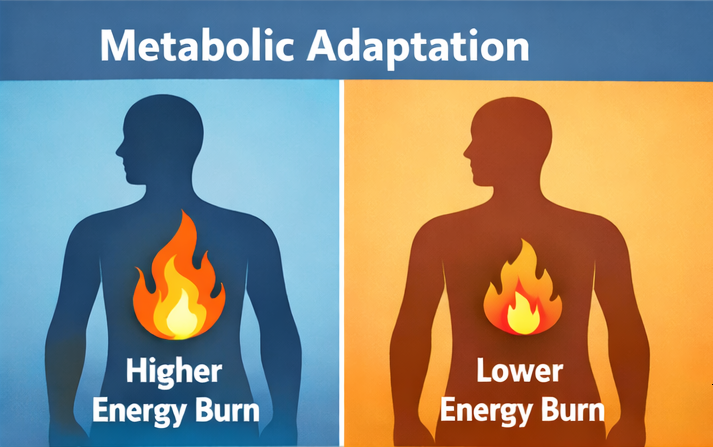
Scientific literature refers to this process as adaptive thermogenesis — a reduction in energy expenditure beyond what would be expected from weight loss alone. In practical terms, the body becomes more efficient and burns less energy than before.
Weight loss also affects hormones involved in appetite, satiety, and energy regulation.
One of the most studied hormones in this process is leptin. As fat mass decreases, leptin levels tend to drop, signaling the body to conserve energy and increase hunger. This hormonal shift can make continued fat loss increasingly difficult.
At the same time, prolonged calorie restriction may increase stress-related hormones, further influencing how the body stores and uses energy.
Emerging research highlights the role of the gut microbiome — the trillions of bacteria living in the digestive system — in metabolism and energy balance.
Scientific reviews suggest that changes in gut bacteria composition can affect how efficiently calories are absorbed, how inflammation is regulated, and how metabolic signals are processed. Dieting, stress, and restrictive eating patterns may reduce bacterial diversity, potentially contributing to stalled progress during weight loss.
In the early stages of weight loss, reducing calories and increasing activity often leads to noticeable results. Over time, however, the body adapts.
As metabolism slows and hormonal signals shift, further restriction can increase physiological stress rather than accelerate fat loss. This may lead to fatigue, cravings, and diminishing returns.
From a scientific perspective, plateaus are not a lack of discipline — they are the body responding to prolonged change.
Rather than forcing additional restriction, research suggests that supporting metabolic balance may be more effective during a plateau.
This includes approaches such as:
Reducing metabolic stress Supporting hormonal balance Improving gut health and bacterial diversity Focusing on long-term sustainability
These strategies aim to work with the body rather than against it.
Research does not point to a single universal solution for weight loss plateaus. Instead, different biological mechanisms may be involved, and nutritional strategies are often explored based on which systems appear most affected.
Many people find it helpful to explore approaches aligned with the area they believe may be limiting progress.
For individuals who believe digestion, inflammation, or metabolic balance may be contributing to stalled progress, gut-focused strategies are often explored.
The gut microbiome plays a role in energy extraction, insulin sensitivity, and metabolic signaling. Supporting bacterial balance may help create internal conditions that are more favorable for ongoing metabolic function during a plateau.
One example of this gut-focused approach is Lean Biome, a dietary supplement formulated with specific probiotic strains and plant-based compounds that have been studied for their role in gut balance and metabolic support.
Some people associate plateaus with insulin-related metabolic resistance, where the body becomes less responsive to signals that regulate energy storage and fat use.
Nutritional approaches in this category often focus on compounds studied for their potential role in supporting glucose metabolism and insulin sensitivity.
One example often discussed in metabolic research is berberine. Berberine Max is a supplement formulated around this plant-derived compound, which has been widely studied for its potential role in metabolic health and insulin sensitivity.
Some people believe hormonal signaling plays a key role in weight loss plateaus, particularly mechanisms related to leptin — a hormone closely associated with fat mass, appetite regulation, and energy balance.
As body fat decreases during weight loss, leptin levels tend to decline. This shift may signal the body to conserve energy and increase hunger cues, potentially making continued fat loss more challenging.
One approach often discussed in metabolic research focuses on supporting energy utilization and hormonal pathways during these adaptive phases.
An example aligned with this perspective is Leptozan, a dietary supplement formulated with beta-hydroxybutyrate (BHB) and mineral-based compounds commonly studied for their role in metabolic function and energy balance.
These approaches are not mutually exclusive, and scientific understanding continues to evolve. Individuals may respond differently depending on genetics, lifestyle, and overall health.
Nutritional supplements are not intended to replace healthy habits or professional medical guidance, but some people explore them as part of a broader, science-informed strategy.
Weight loss plateaus are a common and natural part of the process. They reflect biological adaptation, not personal failure.
Understanding the mechanisms involved — including metabolic adaptation, hormonal signaling, and gut microbiome balance — allows for more informed and sustainable decisions.
For those interested in exploring science-based options aligned with how their body may be responding during a plateau, learning more about these approaches can be a logical next step.
This content is for informational purposes only and does not replace professional medical advice. Individual results may vary.
© 2026 All Rights Reserved.